Dear Enid,
When brainstorming about language and literacy politics, I struggled a bit with making my topic clear. I was always within the lines of learning another language, however I didn’t know who and why I wanted to focus on this idea. I just knew it was going to be about my experience. So when narrowing it down that one day at the library, I had already established the fact that I was going to be someone who would’ve wanted to read this essay back when I was new to this country.
My audience are students who are immigrants from my generation, Gen Z. I’ve tried to make the language of this essay simpler and there are some run-ons to give it the impression of ranting. This is more of a comfort piece to tell my audience that I hear them and there are a lot more of us out there. As I was writing this piece, I really wanted to find a way to connect to all the groups within Asia, however, I think it’s most suitable for those who have had to constantly hear the “doctor, lawyer, engineer” for majority of their lives. Furthermore, a member of my peer review group had mentioned ESL and ELL placements, however, I did not focus as much on that since I was put in it for a month then taken out. Additionally, I didn’t really get the concept as much growing up and just thought they wanted to pay extra attention to me because I was smarter than the rest of the children growing up, well that thought was true right after I was taken out, lol. I’ve incorporated memes and the latest trends growing up so I can connect better with my audience. I feel as if we are hooked when we read something we are interested in. Furthermore, the introduction was intentional because I was incorporating an APUSH(high school)/RACE(elementary and middle schools) method for the “perfect” essay structure, that being context.
The most meaningful insights I’ve gained from Phase 2 will most definitely be researching. The websites and knowledge about putting quotes on exact words I want on essays was helpful in narrowing down the exact type of sources I wanted to use. Additionally, in this essay, I was able to introduce authors, which I also feel is a key aspect in not only providing a person’s credibility when proving your point, but can also be used in real life when introducing someone, as you basically give away their role/standing in society. I’ve also learned from my topic that there are way too many memes out there about situations like these, hinting at dark humor and satire as a whole.
When it comes to writing techniques, I’ve used context, anecdotes, and tone. The introduction of this essay was mainly there to bring back the essay structures schools want children to follow while moving up grades. I wanted to show that there will always be systems to everything, but it is up to the individual to set their own rules and choose how they want to perceive things. Moving onto context, the anecdotes utilized were blended in with my evidence and analysis as I have chosen pieces that resonate most with what I wanted to convey to the Gen Z readers. Lastly, my tone was mixed with formal, relatable, and worrisome. Hence, writing this essay took a lot of thinking as it was supposed to be for my younger self but also for people that can relate to me. I look forward to your feedback!!
The Hidden Struggles of US (Asian Immigrants) in American Educational Institutions
Asian immigration to the United States of America started out as early as the 19th century. With the hope of finding vast opportunities and experiencing freedom, families left their homes in search of the so-called American Dream. However, met with discrimination and labeling, they had no choice but to silently endure what they did not deserve. For many Asians, success became the way out of that label, strongly tied to academic excellence. Yet, this extreme pressure came at a cost for the younger generations trying to live up to their parents expectations, while also adapting to the newfound school system in the United States. Met with their families constant reminders of “lawyer, doctor, or engineer”, their route to success wasn’t always easy. And why should the younger generation accept the path chosen by their parents? Furthermore, considering a completely new environment and different people, you’d think other diverse groups would be accepting. However, children were conditioned to spot, yet, avoid differences by school institutions. Additionally, the lack of support systems in public funded schools for younger children was never met with the bare minimum. They were always separated from the normal kids, treated less than they were, and constantly guilt tripped. Slightly shifting away from this topic, does the flow of this paragraph look familiar to you? The same AP US History introduction New York City public school students, like you, were taught in order to obtain those points in the AP exams?! Anyways…
The negative influence the American school system has on Asian immigrants is beyond unacceptable. An individual’s intelligence being undermined due to the way they speak should not be as normalized as it is today. The usage of simpler words or a slight hint of “slang”, which is completely normal for any young person, should be used as a tool for labeling. The generations that came before us, also had their versions of this life, so why do they think it’s okay for them to label us when they did the same thing? June Jordan, a teacher of Black English at Stony Brook University, had written the essay, “Nobody Mean More to Me Than You And the Future Life of Willie Jordan”, to introduce a different English dialect spoken by a community that has been around for a long time and its rules. She states, “manipulation of language so that the syntax and diction of sentences will tell you the identity of speakers, the probable age and sex and class of speakers, and even the locale”(Jordan, 1988, p. 365). This segment from the text displays the idea that language itself is a powerful tool for self identity. A CHILD should be allowed to express themselves in a way they feel most comfortable, not what others find easier. So, the American school system putting restrictions on the way a growing child speaks their version of English is very detrimental to their early stages of life and adaptation to a new environment. From personal experiences, I have had to write short paragraphs using the RACE formula in elementary school. That led me to wonder why there was only one way to achieve full points for standardized tests, such as the State Exams. Additionally, leading me to struggle with proper grammar as I struggled to write and speak out according to their rules. A child would be able to better voice their opinions if given the chance to use their own voice, not follow a certain criteria for “speaking right”. This puts the thought of always having to approach certain situations the difficult way, demotivating young children from stepping out of their shells. June Jordan’s argument connects to “Test scores, subjective assessment, and stereotyping of ethnic minorities” by Simon Burgess and Ellen Greaves by highlighting the idea that certain stereotypes connected to a person can make others feel a negative way. They set out an experiment to test if teachers truly have low expectations of minority students in this writing. As stated, “teachers make a personal assessment of each child’s level in the same three subjects. The assessment is based on the teacher’s interaction with the child over the year, the child’s performance in in-school tests, and a set of “probing questions”.”(Burgess and Greaves, 2013, p. 539). This shows that the report is completely based on bias. Considering some difficult names and accents, teachers can sometimes get tired of trying to understand you. Has your name ever been pronounced wrong and there was nothing you could’ve done about it? Coming from experience as someone who had to constantly correct teachers, at some point the same scenarios get tiring, so it’s just a whole lot easier to let them continue on with their ways. This can lead to minority students receiving lower subjective scores due to implicit stereotypes about behavior, effort, or ability during classes, even when their measurable performance (such as test scores and other academic accomplishments) is the same as white peers. Thus, school institutions stand as a barrier to a child’s early development.
Parental influence is detrimental to shaping the voices of Asian immigrants. Growing up, many children would have to translate, send emails, or complete paperwork in English for their parents. This second job adds extra pressure on children who have to maintain that “perfect” image at home but struggle with having proper support at school. A primary example of this is Amy Tan, who is a Chinese American author and writer of the essay, “Mother Tongue”, exploring the variations of English that shapes how the listener perceives an individual, through the experiences of her mother. Throughout this narrative, she explains how people were treating her mother poorly due to her usage of grammar and spoken sentence structures. She then mentions her having to step in to assert that her mother deserved to be treated with respect from the very beginning. I resonate a lot with this situation because at times, my own mother would struggle with explaining her problems to people, and ask me to help her word it better. Through these acquaintances, I was able to understand what she must’ve felt was very similar to what I had experienced starting out in first grade, in a completely new country. According to Tan, “ I do think that the language in the family, especially in immigrant families which are more insular, plays a large role in shaping the language of the child.” (Tan, 1990, p. 79). She argues against the claim of peers influencing thoughts and believes that parents play a larger role in that aspect. Her frustrations grew while having to constantly prove her family was literate in the American world. Given the piling expectations and idea of perfection, children start shifting their interests to areas they are able to make their parents proud. As depicted in the meme below, posted on LinkedIn by Alvin Foo, who is a senior internet and mobile media executive and entrepreneur with 20 years of experience. 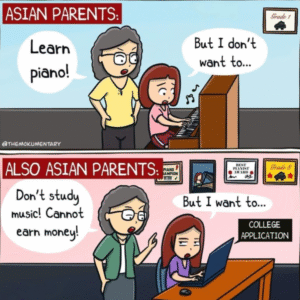 This image shows that the symbol of success to Asian parents is money. They influence you to have other hobbies just so you don’t burn out and stand out in college applications, however, in the long run they want you to pay more attention to career paths that bring higher pay and are respected in society. Currently, people look down on artists as they assume they do not make enough to get by. Driven by this influence, parents become accustomed to believing in the same ideology. Growing up, my parents encouraged me to sing or do cultural art, but the idea of becoming a doctor to help secure their financial future was instilled in the back of my head. This meme connects to Amy Tan’s argument because she highlights the importance of parental influence on children. Specifically, how the desire to make parents proud can create an internal conflict between personal interests and cultural expectations of success. Adding on, the article “Social influence on positive youth development: A developmental neuroscience perspective” written by Eva H Telzer, Jorien van Hoorn, Christina R Rogers, and Kathy T Do differs with the ideas above. These authors are a part of the Department of Psychology & Neuroscience at the University of North Carolina. As stated, “While prior research has examined neural differences between social influence from family and peers, no study to date has delineated how youth incorporate the simultaneous influence of their family and peers into their decisions and behaviors” (Telzer et al, 2017). This published article differs from the meme and Amy Tan because it reframes the social influence to be unimpactful. Whereas Tan’s narrative and the meme highlight the immense pressure, expectations, and demands placed on immigrant children, Telzer and colleagues argue that parental and peer influence does not have to support adolescents’ identity formation nor resilience. Thus, the pressure from parents play a major role in influencing the thoughts and actions of adolescents.
Some say that the influence of peers shapes the identities and behaviors of adolescents, however it is the school environment they are in that play a significant role in the development of their behaviors. A prime example of this are schools without uniforms. Many students are led to follow trends and dress a certain way, which may make them feel as if they are a part of a community. This could include specific designer brands or accessorizing with consumeristic items considered “cool” during the time. For instance, the increased popularity in Air Force 1’s, fidget spinners, smarties (candy) necklaces, chokers, Y2K fashion, men wearing quarter zips in late 2025 (this image depicts the top results for “quarter zip revolution” on TikTok)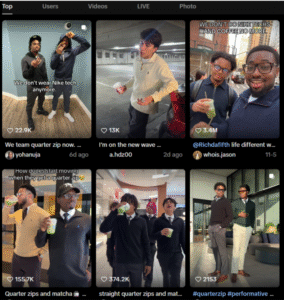 , newest release of iphones, and more. There will always be such trends controlling the lives of the younger generations and simply following those same trends adds a sense of belonging at school. However, given this new environment, Asian immigrant students may find it difficult to fit in as many schools in Asia have strict uniform policies, whether they are public or private. This struggle may lower their self esteem as they try to keep up with the changing trends. Additionally, today’s adolescents use social media and how these behaviors shape their developing self-esteem and self-image was examined in the article “Understanding Adolescent Self-esteem and Self-image Through Social Media Behaviors,” by researchers Linda Charmaraman, Milagros Hojman, Mayva Auqui, and Altynay Bilyalova. In the article, it stated that, “As a normative part of adolescent social comparison seeking, adolescents may build their self-esteem and self-image through social feedback, accepting or rejecting interactions with online peers”(Charmaraman et al, 2024). This evidence proves the idea that social media, which is where a lot of slangs are used, can influence the user, specifically adolescents, to respond in a way that is appealing to whomever they are interacting with on that specific app. Therefore, adolescents’ exposure to their environments, whether it be social media or family/schools, play a major role in shaping their actions.
To conclude, American educational institutions negatively contribute to shaping the lives of Asian immigrant students. Their experiences at home and the school environment not only lowers their self esteem, but also denies them of any true happiness. They are unable to be themselves and have to constantly cater to what others want from them, much like nonvoluntary people pleasing. Nevertheless, this is still not enough as parents and peers continue to push their limits. Examples of this include the constant pressure to be the perfect child and also fitting in to seem cool enough. To move away from these expectations, schools should create an environment where the child feels safer growing up. This can include cultural clubs in elementary and middle schools, interactive learning and activities regarding foreign cultures during class time, and some forms of reward that don’t make the students feel as if learning about another culture is boring. Additionally, the parents of these hardworking children should try and understand how they feel growing up with all the pressure, especially considering the new environment for both age groups. Thus, children should be allowed at least a small amount of freedom to decide the true importance of life and choose how they want to learn in their own journey.
REFERENCES
Burgess, S., & Greaves, E. (2013). Test scores, subjective assessment, and stereotyping of ethnic minorities. Journal of Labor Economics, 31(3), 535–576. https://doi.org/10.1086/669340
Charmaraman, Ph.D, L., Hojman, M.D. M.B.A., H., Quichimbo Auqui, J., & Bilyalova, Z. (2024). Understanding Adolescent Self-esteem and Self-image Through Social Media Behaviors [Review of Understanding Adolescent Self-esteem and Self-image Through Social Media Behaviors]. Wellesley Centers for Women. https://www.wcwonline.org/Journal-Publications/understanding-adolescent-self-esteem-and-self-image-through-social-media-behaviors
Foo, Alvin. “Asian Parents 😁.” Linkedin.com, 27 Apr. 2025, www.linkedin.com/posts/alvinfsc_asian-parents-activity-7322152717022302208-k-Cg/. Accessed 11 Nov. 2025.
Jordan, June. “Nobody Mean More to Me than You and the Future Life of Willie Jordan.” Harvard Educational Review, vol. 58, no. 3, Aug 1988, pp. 363–375.
Tan, A (1990). “Mother Tongue”. Threepenny Review. pp. 76-80.
Telzer, E. H., van Hoorn, J., Rogers, C. R., & Do, K. T. (2018). Social Influence on Positive Youth Development: A Developmental Neuroscience Perspective. Advances in Child Development and Behavior, 54(1), 215–258. https://doi.org/10.1016/bs.acdb.2017.10.003

This entry is licensed under a Creative Commons Attribution-NonCommercial-ShareAlike 4.0 International license.

