Dear Enid,
When you said “I want to be able to recognize YOUR writing,” it caught me off guard. Coming into this class, I never cared for writing for myself, it was always about following rules. So, I didn’t know that I wasn’t expressing certain aspects of my life enough in the drafts of this language and literacy narrative till it was pointed out. In my writing, I don’t want you to recognize just words on the page but picture what you read from my perspective.
After doing some peer reviews, I received feedback on how my writing and certain phrases bring the readers nostalgia. Maybe because the memories of high school are still fresh, people in this class were able to connect more. When I wrote this, I didn’t have an intended audience in mind but my friend whom I’ve shared this moment with. How other age groups would view this—not sure. But my writing counselor did say learning Spanish in a school setting made her feel the same way at first. So, confirming now that my intended audience are people who’ve had to learn a language they didn’t see a point in learning before, specifically immigrant students. I tailored my language around vivid descriptions because as a reader these details benefit me most. What I’d like to figure out next for myself is whether I should write to get a feeling across different age groups or just focus on something sensitive that wouldn’t specifically reach a specific audience group but invoke a certain feeling within.
On August 26th, 2025, the question “How do you think of yourself as a writer? Strengths and weaknesses” had me thinking about the grades I’ve previously received on papers or short writings. I was trying to back up the fact that I could write, which took some time (more so whether or not the grade was based on completion or a rubric) till I actually put something down in my notebook. As dated in the first entry, “I would consider myself a decent writer. My strengths include introducing/explaining a topic, providing opinions, paraphrasing, and sometimes summarizing. Some of my challenges lie in making broad generalizations and writing more, specifically making sense of the flow.” Thinking about this after writing the essay made me realize that for introductions I write down the few thoughts that come natural as I read the question for the first time without actually comprehending what’s being asked of me. A key takeaway from this language and literacy writing for me would be to express myself more. I used imagery to show readers what was around me or what I felt instead of going into depth in my drafts. In this phase, I’ve learned that I should pay closer attention to the main point of the writing and actually read more than once to understand better. As mentioned in the TED Talks, just the littlest of details can distract the viewer/reader, and I am a victim of that but as a writer. Going more into Safwat Saleem’s TED Talk, I took note of how he tried to use voice generators to change his accent so people would pay attention to what he’d have to say because he grew up with a stutter and people online were mocking him. In my drafts, I wanted to remain nonchalant, but that is not what a narrative is about. I was able to successfully write a sequence of events that helped me realize the fun of learning another language.
The terms exigence and rhetoric have mostly impacted my learning and writing practices. I wanted to write this essay to get a point across, that it was okay to feel angsty when being ‘forced’ to learn a language. And you shouldn’t have to do anything unless you truly want to, but society can sometimes work against us. I use anecdote, imagery, diction, and syntax to convey my feelings across the writing because as a reader, these are the first things I take note of. I mainly used diction for the readers to notice how my thoughts are organized and syntax to emphasize certain details in the portions that contain a lot of imagery. Therefore, this phase has taught me that language and literacy isn’t about structure or correctness, but where the speaker’s identity unfolds. I look forward to your feedback!!
Finding my Voice in Another Language
Brrriiinnnggg!! The sound of notebooks and laptops being slammed shut echoed throughout room 114. The minute hand just ticked 2:17 PM, dismissal. “Sientate”, yelled my Spanish teacher. “The bell doesn’t dismiss you, I do,” the classic phrase we all knew too well. While others, ranging from grades 6-12, were storming out the building, the 34 of us were held incarcerated in the squeezed room with no windows. My friend and I exchanged a look of pure annoyance. The familiar bland slides with, AGENDA, in all caps, everything was always in all caps. Don’t get me wrong, I never hated learning another language, it was more so me not getting anywhere. The last two years consisted of the basic grammar exercises and recycled assignments, and this year the cycle persisted once again. I wondered why learning a second language needed to be a requirement when the whole school was already bilingual. My family and friends never spoke Spanish, so will learning the language benefit me at all? The answer was no. It never sat right with me to do things that never served me, learning another language was one of them. But maybe, just maybe, I was being bitter that my precious three minutes were being stolen. I guess the extra minutes of high school meant way less than they do now.
The class finally ended after what felt like an eternity. My friend and I quickly grabbed our 8 lb backpacks and speed walked through the empty halls and out the building. Our clubs were canceled due to it being Valentine’s Day, but why would such studious teenagers go straight home?! We somehow ended up in Captain Tilly Park (Chapin Pkwy. &, Gothic Dr, Jamaica, NY 11432) after grabbing a quick bite at Natalie’s Pizzeria; the classic $1 pizza became $2.50—talk about inflation. The walk up to the children’s playground in the park was full of laughter from reminiscences of hidden jokes and old memories. The pond once filled with ducks was now cold and frosty.
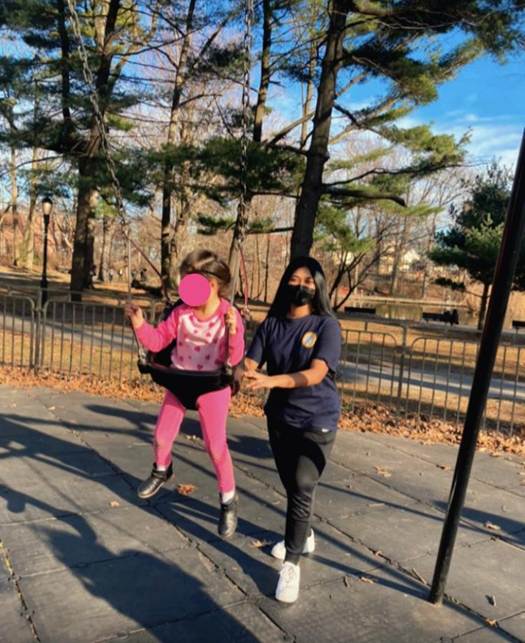
We jumped onto the toddler swings and took turns pushing each other till a little girl, dressed in all hot pink, came along. She had a Dutch braid and was half my height. Even though I go around claiming I despise kids, I still find myself having a soft spot for any that come around. Anyways, she was trying her best to sit on the swings, from using her feet to get up to holding the swing in place. My elder sibling instincts kicked in immediately as I asked her if she needed help while pointing at the swing. She nodded and a smile appeared on her rosy face. I helped her sit on the swing and pushed her gently for a couple of minutes. After a while her mom came along, and I realized a lot of time had passed by as my friend was laughing at me for giving mother vibes. We decided to leave when the mom was asking her daughter if she was having fun in their native tongue, and the girl said, “Gracias” (thank you) out loud. And without realizing, “De nada, ¡adios! ” (you’re welcome, bye!) came out. That’s when it hit me that the 2 years of recycled assignments from my high school Spanish class was worth the extra minutes all along. The mom smiled and thanked me in English, making me feel proud of my communication skills. It was a small moment, but enough to reveal that I wasn’t living a mundane life. That moment shifted my entire look on the language itself.
The next few classes of the semester were not frustrating anymore, I had a reason to pay attention–that one experience. Perhaps I wouldn’t be able to use Spanish with my friends nor family, but there may be opportunities elsewhere. I found myself going to tutoring in that same room with no windows, but I was no longer trapped. I actually enjoyed Spanish and the doors it opened up for me. Leading up to the days of the Spanish Regents, I held my 219 day streak on Duolingo up until June 26, 2024, my junior year of high school. However, after the exam ended, I still found myself going back just for the fun, interactive lessons. Now, I can proudly say those basic grammar exercises are second nature to me.
You can’t force your brain to remember anything if there’s no real connection. I’ve realized that when taking Spanish for 4 years, only realizing its positive impact the third year in. The same requirement I needed for graduation in a fully diverse school allowed me to become trilingual. It wasn’t just a language, but a new world I chose to immerse myself in. Although I rarely use the language itself, it is a great asset to have. What I never chased became a part of my identity and I became someone with linguistic skills after all.

This entry is licensed under a Creative Commons Attribution-NonCommercial-ShareAlike 4.0 International license.


